Youth Development
Youth Behaviour
Emotional Regulation

I sat in on a school meeting once. Years ago now, but it has stayed with me.
A young bloke, mid-teens, smart, funny when he felt comfortable. He had been suspended twice in the past term, and the conversation in that room was going in circles. His parents were frustrated, the school was frustrated. He sat in the corner with his arms folded, completely checked out.
At some point, the deputy principal turned to him and asked: "Why do you keep doing this? You know what is going to happen."
He shrugged, sat quietly for a moment. Then, almost to himself: "Because at least something happens."
The meeting moved on. But I kept thinking about that line.
At least something happens.
He was not glorifying the trouble he was getting into. He was not making a defiant statement. He was telling them, as plainly as he could, that the alternative, going unnoticed, sitting through days that felt like they had nothing to do with him, was worse.
That is not a behaviour problem. That is a belonging problem.
We talk a lot about young people making poor decisions. We talk less about why those decisions make sense to the person making them.
Roy Baumeister and Mark Leary's work on the need to belong advanced a foundational argument in social psychology: human beings have a powerful drive to form and maintain meaningful, stable social bonds. This is not a preference. Their review framed belonging as a fundamental human motivation, and later research has reinforced that when belonging is chronically absent, it significantly affects how people think, feel, and function.
For most adults, this need is met through a mix of family, friendship, work, and community. We do not have to think too hard about it because it is woven into the fabric of daily life.
For a lot of young people, that fabric is much thinner than it looks from the outside.
Adolescence makes this even more acute.
Laurence Steinberg's work on adolescent development shows that the teenage years are marked by heightened activity in the brain's social, emotional, and reward systems, while the systems responsible for planning, impulse control, and long-term decision-making continue maturing into young adulthood. Put simply: the part of the brain that feels, connects, and responds to social signals is already running... HARD. The part responsible for weighing consequences, planning ahead, and regulating those responses is still being built. For most people, that process extends well into the mid-to-late twenties. For some, particularly males, aspects of this development continue into the early thirties.
During this period, young people are particularly sensitive to peer evaluation, social reward, status, acceptance, and rejection. That is not melodrama. It is the brain doing exactly what it is designed to do at that stage of life.
Something I often describe to parents and educators, based on what I see in practice and broadly consistent with the developmental research, is a kind of validation cycle that runs from childhood into early adulthood. As young children, we rely almost entirely on our parents for acceptance and a sense of where we fit. Somewhere around ten to twelve, that starts to shift. We begin forming our own sense of identity. By thirteen to fifteen, the search for that validation turns sharply toward peers. For boys, this often shows up as risk-taking, showing off, and testing limits in front of others. For girls, it tends to look more like social comparison, experimenting with appearance, and an intense sensitivity to peer feedback. By sixteen to eighteen, a more settled personal identity starts to emerge.
For young people who had a strong foundational relationship with their parents, something interesting often happens in the late teens to early twenties: that parental bond starts to resurface. Not as the old authority structure, but as something closer to a genuine friendship. The young person begins to come back to the adults who were there at the start, now on more equal terms. I lived this myself, and I see it regularly in my work.
None of this means young people should be left without structure. Boundaries still matter, and the research is clear that they tend to work best alongside genuine warmth, support, and guidance, not instead of them. Understanding the developmental drivers of a young person's behaviour is not an argument for a free pass. It is an argument for responding in ways that actually work.
Young people are not simply being dramatic when belonging feels like everything. At that stage of life, acceptance, rejection, friendship and social status carry real weight. Developmentally, it makes sense.
Here is where it gets complicated.
The social structures that have traditionally helped young people build a sense of belonging are not equally available to everyone. Stable family environments, consistent adult relationships, school communities that feel genuinely inclusive, sport and extracurricular life, and neighbourhood connection still matter deeply. But for many young people, access to those things has become more uneven.
That is not a simple observation, and I am not romanticising some golden past. Family structures have always varied. Communities have always had gaps. But the data, and the lived experience of people working closely with young people, point to the same concern: a significant number of young people are entering adolescence with a real belonging deficit.
Travis Hirschi’s social bond theory, developed in the 1960s, still gives us a useful way to understand what happens next. Hirschi argued that harmful behaviour becomes more likely when a person’s bonds to conventional society are weakened or broken. Those bonds are built through four things: attachment to people who matter, commitment to future goals worth protecting, involvement in prosocial activities, and belief in shared values.
When those four bonds are present and strong, they function as an anchor. Not because a young person consciously weighs up every risk and consequence in the moment, but because they have something to lose. They have people, goals, routines and values that connect them to something beyond the impulse of the moment.
They have somewhere they belong.
When those bonds are weak or absent, something else can happen.
Robert Agnew’s strain theory helps explain the internal pressure that can build when a young person experiences ongoing stress, rejection, unfairness, blocked goals, or a gap between what life was supposed to look like and what it actually is. That strain does not just disappear; it needs somewhere to go. The direction it takes often depends on what is available.
This is the part most people find hardest to accept.
The conventional narrative around youth crime and antisocial behaviour tends to treat these as fundamentally irrational choices, poor impulse control, moral failure, an absence of values or a combination of these things. Sometimes that is part of the picture. But more often, when you actually sit with young people and have honest conversations, what you find is that their choices have a logic.
A deeply human logic.
Belonging, safety, identity, respect, loyalty.
These are not inherently antisocial motivations. They are universal ones. The problem is not the motivation; it is the environment available for meeting it.
A young person who has been chronically dismissed by school, who feels invisible at home, who has never found a sporting team or community group that genuinely welcomed them, and who is then offered by a peer group or crew a real sense of being valued, protected, and seen, is not making an irrational choice. They are making a completely understandable one, given what is on offer.
Terrie Moffitt’s work on adolescence-limited versus life-course-persistent offending is useful here too. The majority of young people who engage in antisocial or criminal behaviour are doing so as a response to adolescent circumstances, not as an expression of fixed character. When circumstances change, behaviour tends to change. The implication matters: these young people are not destined for harmful pathways. They are responding to an environment that is not meeting their needs.
Understanding this does not mean excusing the behaviour. It means understanding it accurately enough to actually do something useful about it.
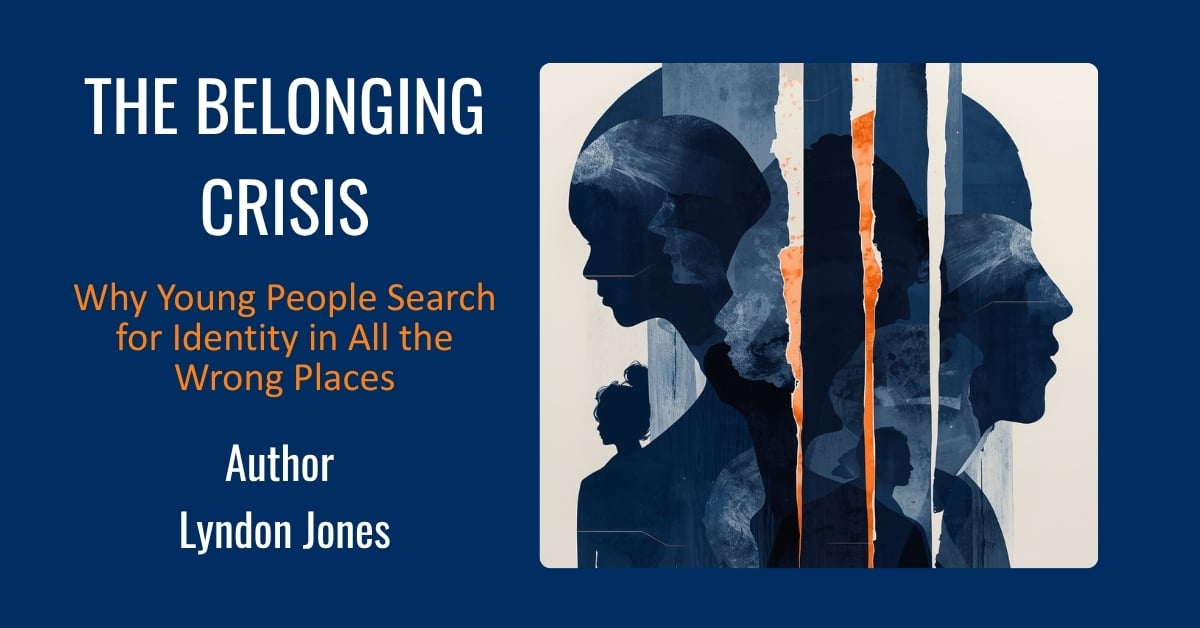
One of the defining features of the current belonging crisis is the role of digital culture.
For many young people, online communities have become a major source of identity and social connection. That is not automatically a bad thing. Online spaces can offer friendship, support, shared interests and a sense of being understood, especially for young people who feel isolated in their offline world.
But online belonging is a particular kind of belonging.
At its worst, it is built around performance rather than genuine connection. Around agreement rather than growth. Around shared identity positions rather than real relationships. Around knowing who is “in” and who is “out”, rather than learning how to contribute, repair, disagree and mature alongside other people.
That is not nothing. But it is often thinner than the belonging young people actually need.
When online connection becomes a replacement for real-world connection rather than a supplement to it, it can leave young people more connected on the surface and more isolated underneath.
There is also the problem of platform design. Algorithms are very effective at learning what holds a young person’s attention. A young person searching for identity, confidence or community can quickly be served more and more content that gives them a sense of belonging through tribal affiliation, ideological identity or group membership.
This does not only apply to obviously extreme spaces. It can happen across gaming subcultures, fitness communities, lifestyle content, political spaces, masculinity content, body image content and more openly harmful ideological spaces.
The young person searching for somewhere to belong online will find somewhere.
The question is what that community will ask of them in return.
I want to be careful here not to reduce this to a list of professional recommendations, because the honest answer is simpler, and harder, than any program or framework.
Genuine belonging is built by people, not initiatives.
The research on protective factors in youth development is extensive, and the consistent theme is not that one particular curriculum solves the problem. It is that young people need stable, caring, consistent relationships with adults who know them, notice them and keep showing up.
One person who shows up.
One person who genuinely knows them.
One space where they feel authentically valued.
The mentoring research supports the point that a meaningful mentoring relationship can make a real difference in a young person’s life, not only because of what the mentor teaches, but because of what the relationship communicates: you matter to someone who does not have to show up for you, but chooses to.
That is a message that cuts through a lot of noise.
For anyone working in schools, sport, community organisations, justice settings, or any other space where young people show up, the most important question is not simply “what programs do we have?”
It is: “Do the young people in this space genuinely feel like they belong here?”
Not tolerated.
Not managed.
Actually belonging.
The ones who are hardest to include, the most disruptive, the most withdrawn, are often the ones for whom this question matters most urgently.
The need to belong is completely legitimate. It is human. It is not a weakness, and it is not something to be embarrassed about.
But the communities and groups we choose to belong to can shape who we become in ways we do not always notice at the time.
Identity forms in relationship. The people around us become a kind of mirror. What they reflect back shapes how we see ourselves, what we think is normal, what we are willing to accept, and what we believe we have to become in order to stay connected.
If the community you are part of is building you up, challenging you, expanding who you are, that is worth protecting.
If it is asking you to shrink yourself, to prove loyalty through harm, or to trade away your integrity to stay in the group, that is worth questioning.
Even if the alternative feels uncomfortable.
Even if you are not sure where else you fit.
You deserve a community that is genuinely good for you. That is not an unrealistic expectation. It is a legitimate one.
At NextGen Edge, we talk about building identity, resilience, direction, and confidence. But underneath all of it, there is something more fundamental.
Every young person deserves to belong somewhere that is genuinely good for them.
That is not an abstract goal. It is the concrete, practical work of youth development, and it does not start with programs. It starts with the question every adult working with young people should be asking themselves, regularly and honestly:
Does every young person in my world feel like they genuinely belong here?
Not as a policy position.
As a real, felt experience.
Because when that answer is yes, a lot of other problems become less likely, and the problems that do appear become easier to address. But when the answer is no, all the rules, warnings, and frameworks in the world will not fill the gap.
The belonging crisis is real. But it is not inevitable.
It is a human problem, and it requires a human solution.
That solution starts with the adults in the room choosing to make their space genuinely worth belonging to.
NextGen Edge is a youth education, coaching, and mentoring organisation committed to helping young people build the identity, resilience, and direction they need to navigate modern life. We also work with families to reshape how young people are seen and supported within their own homes and communities, because the best outcomes happen when the whole village is moving in the same direction.
For more writing on youth development, behavioural understanding, and the realities shaping young people's lives today, follow us on LinkedIn, Facebook, Instagram, TikTok and YouTube.